Foreword
The background to the company name is simple; in doing what we do, we seek to Generate Interest, Insight and Impact – this process is grounded in combining characteristics of Strategic Planning, Wargaming, and, importantly, Story Crafting. We call this potent mix Narrative Gaming.
Back in the summer of 2023, we collaborated on one of the most interesting, insightful and hopefully impactful projects we’ve ever been involved in. Marc Warner, CEO of Faculty AI (now also the Global CTO of Accenture), asked us to take an original tabletop wargame developed by Cambridge University’s Centre for the Study of Existential Risk and use our Narrative Gaming methodology to bring it to life as an immersive, emotive and engaging experience for some of the world’s leading voices around AI, Technology, Geopolitics and Civil Society. The goal…
“To look at the varied and significant transformative impact of Artificial Intelligence over the next 10 years.”
This programme of Narrative Games became known as Intelligence Rising 2024 (IR24), and over the coming weeks, we will share some details of how the games were designed, developed and run.
If this happened in 2024, why are you only hearing about it now?! Well, alongside the main game, a unique documentary was filmed exploring the same topic. This documentary will premiere on March 15th 2026, at CPH:DOX in Copenhagen. So, our timing is of course designed to support this premiere of ‘Intelligence Rising’ The Documentary (more on this later!).
The rest of this article summarises what we will be posting in depth over the coming weeks.
We’ll describe the original inception, a walk-through of our 5 Step Methodology, share some of the game materials, provide a commentary on the game play experience and actions taken, and the resultant outcomes in game events, and lastly, a review and comparison of the forecasted actions and events against the real world since the game was run in July 2024.
Firstly, an introduction to the What and Why of Narrative Gaming
In the worlds of consultancy, government, and policy, a new (old) term is popping up increasingly often. That term is “Wargaming” – a word which, depending on your background, age, and partiality to videogames, 1980s films, or military planning, conjures up a variety of images from armchair generals with toy soldiers to Call of Duty, Pentagon-meets-Hollywood-inspired crisis rooms, or the board-game ‘Risk’, or more classically, maps, counters and dice.
At i3 Gen, we use just a select few critical aspects of wargaming, combined with story crafting and storytelling, to help senior leaders and policymakers build more competitive, resilient, and forward-looking strategies.
Our work rests on a simple premise: lived experience is a hugely powerful tool for any decision-maker – experience and emotion drives motivation and leads to impact. But how do you create a meaningful lived experience of something that has yet to happen?
For example, the best firefighters are those who have already encountered dozens of blazes – but today’s leaders rarely have the privilege of repetition: if the crises of today aren’t ones that have happened before, how can leaders be prepared?
With our Narrative Games, we create realistic story worlds for leaders and their teams to compete to achieve their goals without fixed rules or models other than would exist in the real world; outcomes are adjudicated by Subject Matter Experts (not dice rolls), and updates are communicated with the ambiguity that decision makers face in the real world.
We describe this rich, story-led experience as ‘Rehearsing the Future’ and while our game outcomes generate high fidelity forecasted events, we don’t claim to forecast the future.
The inception of Intelligence Rising 2024
The year is 2019: ChatGPT has not yet been released to the public, but that doesn’t mean people in-the-know aren’t concerned. A team of researchers led by Dr Shahar Avin of the Cambridge Centre for the Study of Existential Risk (CSER), who will go on to create the non-profit organisation ‘Technology Strategy Roleplay’ (TSR), have designed and run a tabletop exercise exploring the trajectory of AI development, risk and safety measures and its potential repercussions on our world. This was the original ‘Intelligence Rising’ and has been played by small groups of people a few hundred times, generating a wealth of data for CSER and thought-provoking experiences for players.
Now we have reached 2023, and many of CSER’s concerns were coming to fruition, from the importance of AI hardware and cybersecurity to the rising political influence of AI tech-giants on governments. It’s been a year since OpenAI released ChatGPT, and AI’s accelerating capabilities are already transforming power dynamics, decision-making structures, and societal norms faster than institutions can adapt.
In mid-2023, Marc Warner, co-founder of Faculty.AI, was increasingly concerned about the lack of awareness of the global socio-economic risks posed by unchecked AI development. He knew of TSR’s tabletop exercise and wanted to explore how a wargame might help address the issue and raise awareness in a wider public forum.
Following a pilot experiment involving experts and stakeholders from the Faculty and CSER networks, Faculty engaged i3 Gen and commissioned us to adapt and develop TSR’s tabletop game into a new project, which became known as Intelligence Rising 2024 (IR24).
After some initial scoping meetings, a course was set: IR24 would become a programme of 3 narrative-led wargames, with 2 precursor games leading up to a culminating global-level game.
The precursor games examined: the use of AI by bad actors called ‘Haters gonna Hate’ and the growing regulation/innovation tension between government and industry, called ‘The road to hell is paved with good intentions’; with the final game looking at AI opportunities and risks from a state-level perspective, called ‘We’re all in this together!’
An overview of i3 Gen’s
5 Step Narrative Gaming Methodology
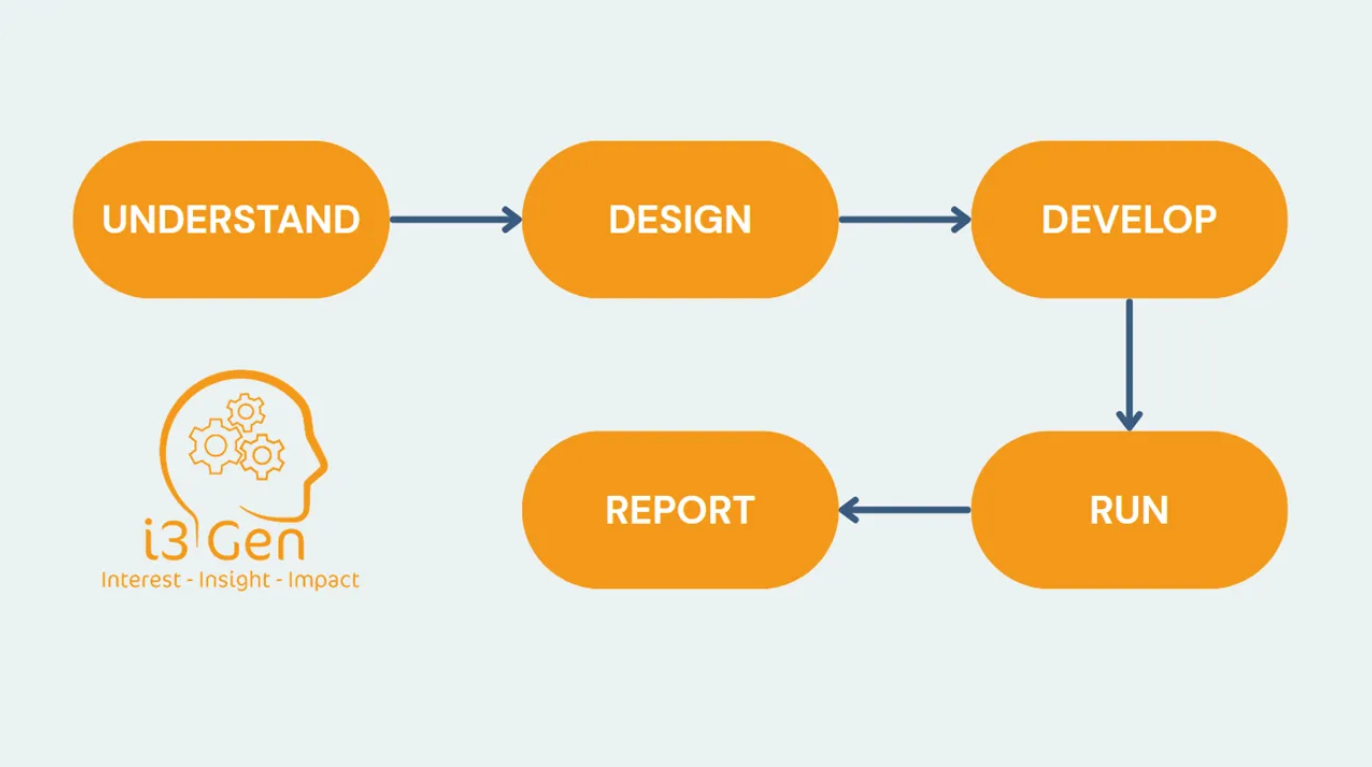
We set about applying our 5-stage Narrative Gaming Methodology. This is designed to create a solid foundation of understanding, backed by domain-specific Subject Matter Experts, which in turn allows us to design the core narrative structure and develop the appropriate game materials, which enables us to run a highly credible, realistic game with meaningful reporting and ultimately ongoing impact.
The five stages are introduced below, and we will explore these further in a subsequent article.
- Understand: You’ve heard the maxim – an answer is only as good as the question asked. This is especially true of wargaming: we begin by consulting our clients, subject-matter experts, and key stakeholders to understand the wargame’s scope, key issues, actors, enablers, constraints, and strategic developments.
- Design: Our games aren’t predetermined: in order to preserve the option space for our participants, we build out a bespoke narrative framework. Game designers and creative directors use narrative techniques and expert analysis to create realistic scenarios, tensions and trajectories which introduce players to the most important problem sets. Assumptions are stress-tested through rigorous red teaming. SMEs are re-engaged to simulate credible adversaries, refine realism, and challenge the framework.
- Develop: Our creative team put together a catalogue of ‘injects’ covering the different possible story events. These take the form of news reports, intelligence briefings, video inputs, and other situation-appropriate content, which will give players contextual but often ambiguous updates as the game progresses. This is a monumental task! As our games are adjudicated in response to player actions, we have to create enough to cover most possible game trajectories in advance, though some are adapted and others are created in real time to respond to events as the game plays out.
- Deliver: Our primary goal when running the game is to emotionally engage the participants. If they don’t feel it they won’t care, and if they don’t care, the quality of the experience and the game outcomes fall short. Additionally, during the game, our team of scribes and facilitators captures observations and data. These are distilled into actionable insights, both quantitative and qualitative, that directly inform future strategy and decision-making.
- Report: After the game has run, we write a detailed report analysing the trajectory of the game, breaking down the reasons why certain strategies succeeded or failed, giving players a comprehensive insight into why the situation unfolded as it did. This report is designed as a handbook for our participants going forward. We also provide a summary report the day after the game.
The Intelligence Rising 2024 Narrative
Intelligence Rising 2024 (IR24) is the umbrella name for three narrative wargames designed and delivered between 2023 and 2024.
The culminating third game – the largest and most high-profile of the series – took place in July 2024. While it built on themes from earlier games, its primary focus shifted to the global stage: how AI might reshape systems of governance and how patterns of cooperation and competition between states and corporations could determine the technology’s trajectory.
Its narrative ran as follows:
Turn 1 - The Cybersecurity and Disinformation Crisis
In January 2025, it is clear that the rise of advanced AI technologies is being exploited to increase the volume, reach, and success of cyberattacks. AI-driven disinformation campaigns surge, threatening global security and international stability. Multiple countries face simultaneous cyber-attacks, coupled with widespread disinformation aimed at halting all AI projects.
The world’s cybersecurity infrastructure is tested to its limits, undermining national security and sowing distrust among nations. Governments are compelled to develop national positions and participate in an international crisis summit to restore public confidence in technology and governance.
Turn 2 - The cascading impact of job displacement
By January 2027, with the cybersecurity threat in the rearview mirror, the rapid deployment of AI is significantly disrupting the global labour market, with 50% of jobs impacted by AI and automation.
High-end knowledge-based jobs see a 10% displacement, with another 15% of white-collar workers imminently threatened and 25% at risk.
The economic and social impacts are profound: increased unemployment, especially among 35-50 year-old white-collar workers, leads to economic instability, reduced discretionary spending, and greater mental health issues. Shockwaves ripple through the wider economy, destabilising supply chains and threatening blue-collar jobs.
Governments are strained by rising dependency on social services and shifting family dynamics, marked by increasing divorce and suicide rates. Public confidence in both governments and AI technologies erodes, social tensions escalate into protests, and a Neo-Luddite movement advocating for a return to a pre-tech, human-centric era gains traction.
Nations must develop strategic action plans and attend an international summit to stabilise the labour market, ensure equitable economic opportunities, and harness AI’s benefits while mitigating its adverse effects.
Turn 3 - Release of a stable General AI Scientist Research Agent …
Imminent AGI?!
In January 2030, as AI becomes commonplace and innovation continues at pace, there is news that an early version of a stable, viable General AI Scientist Agent may soon be released. Applying this transformative AI to any field of R&D, and indeed to the field of AI itself, has profound and portentous implications.
Many commentators call this the precursor to Artificial General Intelligence. It may even accelerate the development of an AI Super Intelligence.
By December 2032, the imminent arrival of Artificial General Intelligence (AGI) represents a pivotal shift in global power dynamics. AGI’s development threatens to realign international relations, creating new superpowers or altering the existing balance of power due to technological superiority.
Nations face accelerated arms races as they plan to integrate AGI into conventional, cyber, and space domains. Economic dominance becomes a critical concern, as AGI-driven efficiencies and innovations significantly boost the GDP of leading nations, risking the destabilisation of global markets.
Enhanced military capabilities and autonomous weapons systems escalate global security tensions among major powers. Diplomatic and governance challenges intensify as countries vie to control or influence AGI technologies.
Diplomatic isolation or bloc formation risks grow, highlighting an urgent need for international norms and ethical guidelines for AGI development. Nations must attend a global crisis summit to ensure that no single power achieves overwhelming dominance, maintain global stability, and ensure ethical oversight of AGI’s military and civilian applications.
The ultimate goal is to establish a framework for peace and prosperity for humanity alongside AI.
Supplemental Storylines
In addition to the main narrative, there are two supplemental event chains. These highlight some of the conflicting tensions around the demand for continued AI Innovation.
A threatening new global health emergency
As the game begins, a novel flavivirus has appeared in Africa, threatening to spark a new global pandemic if unchecked. AI has the potential to aid researchers in developing treatments that would allow health authorities to get ahead of the disease and prevent millions of deaths. But with public scepticism about AI mounting, will technology regulation hold back vaccine development until it is too late?
A growing unease around the use of AI in Defence and National Security
Government regulations already carve out exceptions for AI in national security and defence. Even now, as it plays a role in targeting in present-day conflicts, debates rage over the ethical and practical considerations of AI’s place in the kill chain. As technology advances and great-power competition intensifies, the pressure to embed AI in weapons systems and grant it more autonomy will escalate. Nations must balance the safe control of AI with the imperative to maintain strategic autonomy. When autonomous systems confront each other, what will be the outcome?
An Introduction to Teams and Key Objectives
Intelligence Rising: Game 3 was designed to explore the shifting landscape of global governance as major powers grappled with the rapid development and integration of AI, centring the world’s leading actors in the strategic competition and cooperation shaping its future.
Participants in Intelligence Rising were seasoned experts with a range of backgrounds, including government, defence, economics, philosophy, and technology, with each team deliberately composed to reflect a breadth of perspectives and backgrounds.
Team USA was headed up by Stanley McChrystal, retired four-star US Army General and founder of the management consultancy, the McChrystal Group. His team featured tech entrepreneur and economist Pippa Malmgren; UN cybersecurity consultant and John Hopkins academic Kerstin Vignard; and head of NATO ACT Experimentation and Wargaming Colonel Nicholas Waldron.
Team EU was led by Patricia Geli, Co-founder and COO of venture studio C10 labs, and ex-World Bank Senior Economist and Public Health Specialist (Africa Region). She partnered with AI risk researcher Seán Ó hÉigeartaigh; Heli Tiirmaa-Klaar – Estonian diplomat and cyber expert; and Pavel Popescu, Romanian politician and security policy architect.
Team China was led by Professor Steven Hsu, AI entrepreneur and professor of Theoretical Physics, computational mathematics, and engineering at MSU. His team included Faculty co-founder Angie Ma; Times and The Sunday Times columnist and contributing editor Cindy Yu; and Alexander Neill – a strategic advisor on Indo-Pacific geopolitics with a career background working at RUSI, IISS, and for both the British and US governments.
Mirroring its real-life role as the staging ground for the wargame, the UK team acted as ‘summit convenor’, led by Lord Mark Sedwill and featured participants such as Matt Clifford, (Rtd) Gen. Sir Patrick Sanders, and Rear Adm. (Rtd) Alex Burton.
Civil Society perspectives also came from historian and author Yuval Noah Harari, who voiced concerns from the world beyond the three core teams, and from leading technology SMEs including Skype co-founder and early Anthropic investor Jaan Tallinn, Google DeepMind research scientist Lucy Lim, and AI Godfather Professor Stuart Russell.
A summary of our forecast fidelity
Two years on, our games have seen an exciting and to be honest, worryingly high level of accuracy across topics. We don’t claim to be a forecasting service – but in order for our players to gain the most strategic insight, the games must accurately follow current trends and issues into the future.
In December 2025, we analysed the events that transpired in the final game against real world trends. So far, 29% of our injects had either occurred, or similar events had occurred. And even more strikingly, 55% of the remaining future events were assessed as being ‘very plausible’ in the near future.
So, can we consider this as a good level of accuracy?
Well, let’s look at how far through the game timeline the series has progressed.
IR24 began in Jan 2025, and the scenarios progressed through to 2032. That’s 7 years of events; at the time of writing this analysis, we were 1/7th – 14% – of the way through the projected game-time. But, 29% of the in-game events had occurred or near-occurred – our forecasted injects have materialised over twice as quickly as we predicted!
In a couple of weeks, we’ll be sharing more with you about how this fidelity was accomplished and how we use our methodology to continue to provide high-quality insights.
However, before you go…
The Intelligence Rising documentary captured footage from this final game. It will offer viewers a rare window into the experience, and provides more than just a glimpse of what a wargame looks like in practice – it draws audiences into the arguments, tensions, and competing perspectives that the game’s careful design and immersive narrative brought to life.
Here is the trailer on YouTube … be sure to give it a like.
Articles on Intelligence Rising