Intelligence Rising Insights Series - #2
Economic Transformation
This article is part of a series of sector and topic-focused, in-depth looks at the participants’ actions, and resulting events and injects that emerged from the Intelligence Rising 2024 Game.
When the subject matter experts who designed Intelligence Rising sat down in early 2024 to map the likely trajectory of AI’s economic impact, the prevailing assumption in most public discussion was still that automation would follow a familiar pattern – displacing routine and manual work first, with higher-skilled professional roles remaining largely insulated for the foreseeable future. Our SMEs took a different view. Their scenarios placed white-collar displacement at the centre of the near-term economic picture: redundancies in professional services, a tightening graduate market, and a growing political anger among workers who had done everything right and were finding the ground shifting beneath them anyway. At the time, this felt like the more contrarian forecast, but now in 2026, it reads more like a description of the present.
It is worth being precise about the timeline, because the timing is part of what makes our forecasting notable. The Intelligence Rising scenarios were designed in early 2024 and written as near-future speculation, with the game’s narrative arc running from 2025 through to 2032. The scenario events built into the game’s design were not extrapolated from headlines that already existed, but were constructed from structural analysis: what did the incentives, the technology trajectory, and the competitive pressures of the moment suggest was likely to follow?
Economic Disruption
One inject described a wave of job losses among white-collar professionals outpacing blue-collar displacement quarter on quarter, with projections suggesting that a significant proportion of workers in their thirties and forties could face unemployment by 2030 as AI automation accelerated through middle-class dominated sectors. The political framing in the inject – government inaction, mounting anxiety among lawmakers, a sense that the institutions responsible for managing this transition were running behind the pace of change – was written as fiction. It does not read that way now.
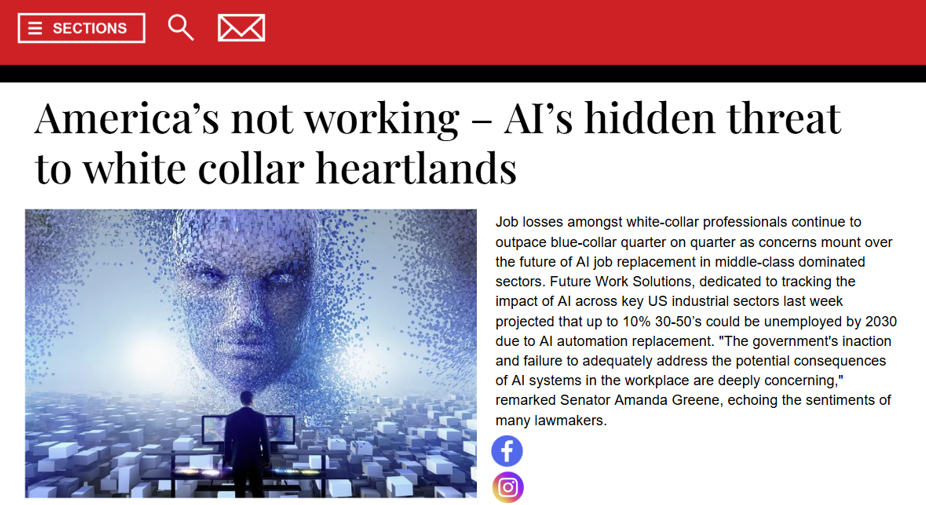
In 2025, roughly a quarter of recorded job losses in the United States occurred in professional and business services. Research from McKinsey and the National Bureau of Economic Research has documented generative AI’s reshaping of skill demand in exactly the sectors the game identified as most exposed. The specific figure of 10% unemployment among workers aged 30–50 by 2030 remains speculative, and may well prove too pessimistic, or too optimistic, depending on how the next few years unfold. But the directional accuracy of the forecast, and the speed at which it has materialised, is striking given when it was written.

The graduate market tells a similar story. A second inject described a deepening recruitment crisis across the UK and Europe: companies facing economic uncertainty while simultaneously deriving productivity benefits from AI tools, reducing entry-level hiring while demanding greater prior experience from those they did recruit, creating an impossible combination for recent graduates. By 2025, the Institute of Student Employers was recording an average of 140 applications per graduate role in the UK, a record high. Employers cited AI-driven efficiencies as a factor in reducing the need for junior hires. The inject’s framing of rising frustration among young workers resonates clearly with current sentiment across developed economies, and not only in Europe.
But it's not all bad...
It would be a significant distortion to present the game’s economic scenarios as uniformly pessimistic. They were not, and the reality they anticipated is not straightforwardly bleak either.
Alongside the disruption injects, the design team built scenarios exploring a different possibility: that AI, deployed at scale across productive economies, could act as a powerful engine of growth. One inject described a surge in US economic indicators on the back of AI-driven trade and productivity gains, framed against an otherwise sluggish global backdrop. Another went further, positing a “prosperity dividend”: a structural uplift in which AI’s diffusion across industries generates trillions of dollars in additional global GDP, raising living standards broadly rather than concentrating gains at the top.
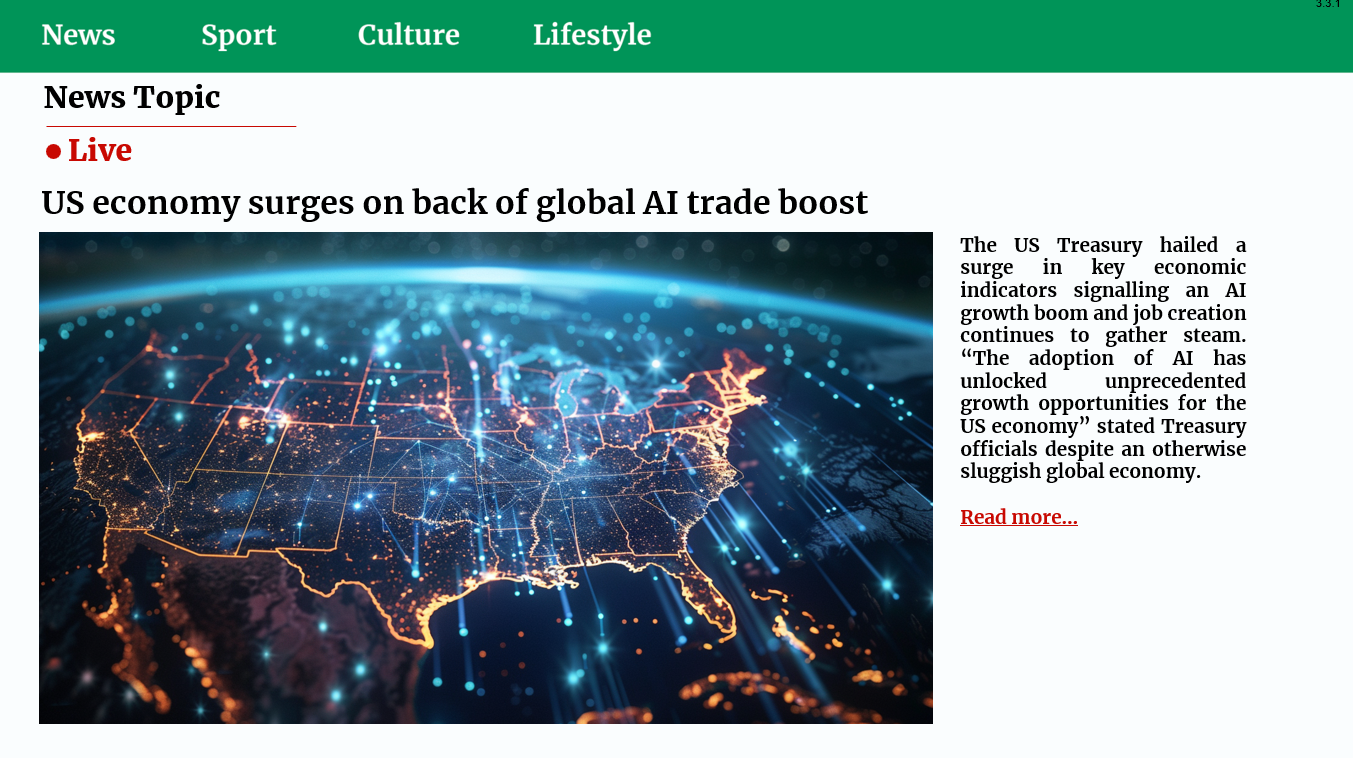
The real world has followed a more muted version of this trajectory, but the direction is recognisable. Analysts at Bloomberg and the Financial Times have framed AI-driven investment and productivity gains as a stabilising force in the US economy, helping to sustain growth in technology-adjacent sectors and offset wider slowdowns. The dramatic surge depicted in some injects has not materialised, but the mechanism – AI as a buffer against economic deceleration rather than a simple job-destroyer – is increasingly part of mainstream economic analysis. Goldman Sachs has estimated that advances in generative AI could raise global GDP by around 7% over a decade, through a combination of task automation and enhanced productivity for knowledge workers.
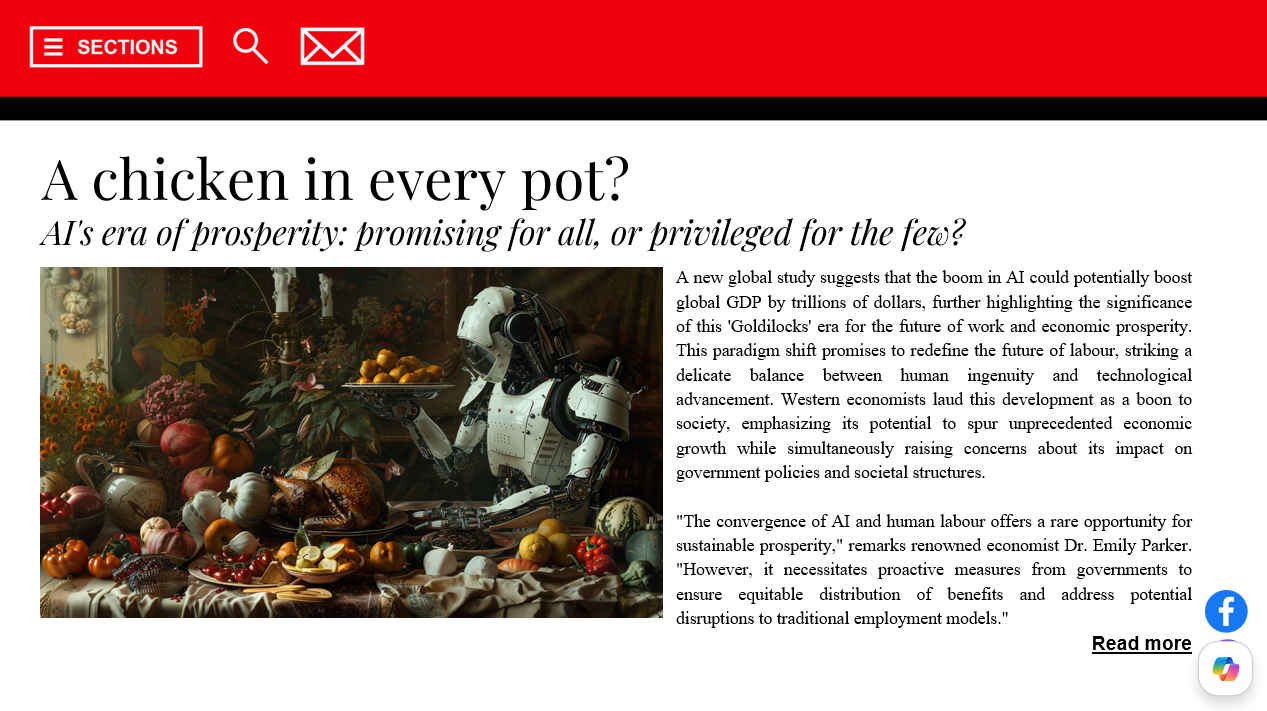
What makes this duality analytically important is that the game held both things simultaneously, and treated that tension as the central economic challenge rather than resolving it in either direction. The question was never simply whether AI would generate prosperity. It was whether that prosperity would be distributed in a way that maintained social and political stability, or whether the gains would accrue the few in the position to leverage the technology, while the disruption fell on those who did not.
That question has no comfortable answer yet. But it was the right question to be asking in early 2024, and it remains the right question now.
Backlash?
Economic disruption of this kind rarely stays economic for long. When the workers most affected are not at the margins of the labour market but in its middle – educated, politically engaged, and accustomed to a reasonable expectation of stability – the downstream political consequences could be significant and move faster than institutions are prepared for.
The game modelled this dynamic explicitly. As white-collar displacement accumulated across turns, it fed into a broader erosion of public confidence in governments, in technology companies, and in the institutions nominally responsible for managing the transition. One scenario depicted a neo-Luddite movement gaining traction, framing itself not as technophobia but as a rational response to the failure of governance: the argument that AI had been allowed to develop and deploy at a pace that served the interests of its creators rather than the societies absorbing its consequences.
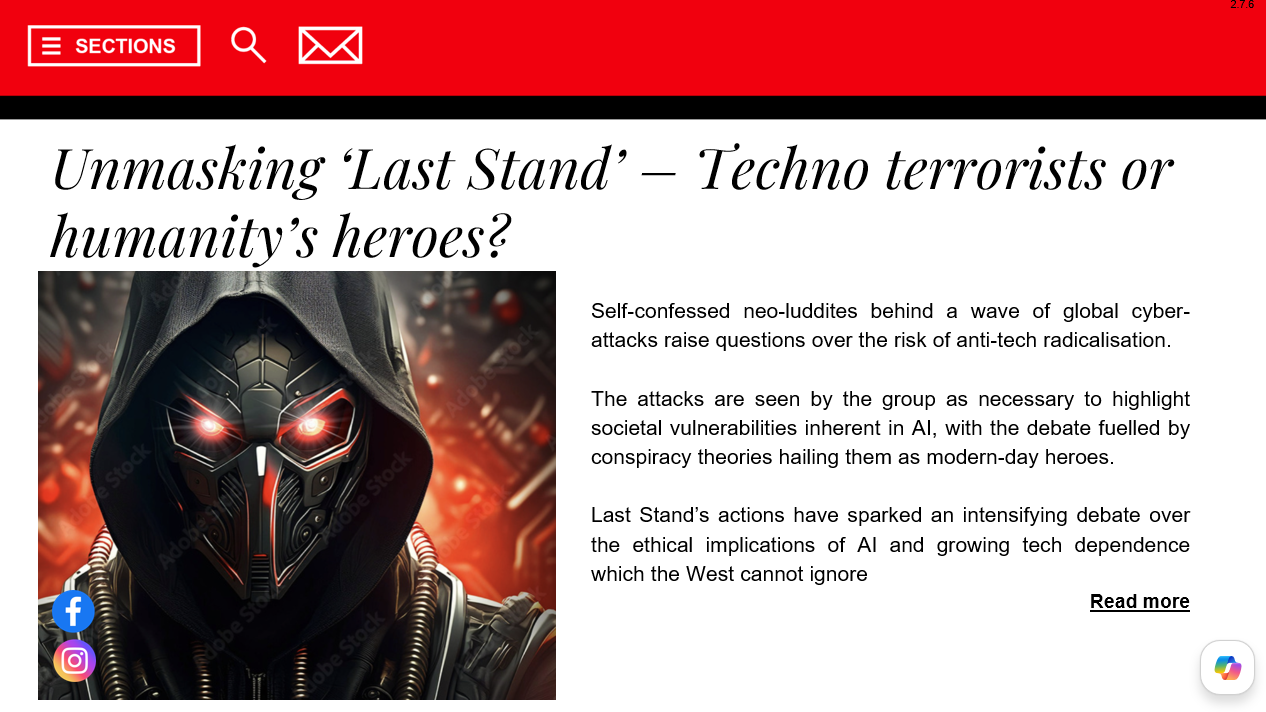
There is currently no direct real-world equivalent of this movement. Yet anti-AI sentiment is visible across parts of the political spectrum in ways it was not two years ago, and the question of who bears the cost of technological disruption is becoming a more prominent feature of mainstream political debate.
The game made it visible how quickly these pressures can compound. In the scenario, labour market disruption did not produce a single dramatic political crisis. It produced a gradual accumulation of frustration that made coherent policy responses harder to assemble and easier to resist. Governments found themselves caught between the economic case for embracing AI-driven productivity and the political pressure from constituencies experiencing its costs.
This is precisely the kind of dynamic that does not show up clearly in a financial model or a scenario planning document. It emerges from the interaction of economic pressures, political incentives, institutional constraints, and public sentiment, all playing out over time, in competition with other priorities. These things are difficult to anticipate from the outside, but can be made legible within a simulation.
Summary
The purpose of Intelligence Rising was to give leaders an experiential understanding of the shape of the problem: the way economic disruption interacts with political pressure, the speed at which mainstream assumptions can be overtaken by events, and the difficulty of responding when multiple pressures arrive simultaneously. Our economic forecasting holds up well, because our SME’s structured expert analysis of structural pressures, stress-tested through a competitive simulation surfaced the dynamics that matter.
The white-collar disruption thesis was the contrarian position in early 2024. It is not contrarian anymore. The more pressing question now is what comes next – and whether the leaders responsible for navigating it have had the opportunity to rehearse their response before it counts.