Intelligence Rising 2024 - Forecast Fidelity
How the foundational design and game events align to reality, so far*?
*This assessment was done in December 2025
This is the fifth article in our long-read series about Intelligence Rising 2024 and follows on from the insight into our game design process. The two articles together provide a view of the beginning and end of the Intelligence Rising 2024 methodology; in the middle sits game content development and the game experience itself.
By way of recap; in July 2024, i3 Gen & TSR ran a Strategic Narrative Game looking at the impact of AI at a Global level.
Throughout the game, the world state is presented to players through a series of structured briefings and injects. Each turn started with a video briefing based on the forecasted, inevitable confluences around AI Impact. These video briefings were then supplemented by a range of tailored injects, typically framed as news reports, intelligence updates, or formal briefing notes.
These briefings and injects create a story-led world where the players develop their strategies and action plans, but how realistic were they?
It is important to note that our games are designed to be fully open sandbox experiences; nothing is off the table, and participants can push the state of the world in any direction through their actions.
During the design process, we consider the most likely and most impactful trends, and create an options space of possible future trajectories. Our analysis often indicates that some outcomes are more likely than others, so we focus game development effort on those accordingly. In the event that the game swings in an unexpected direction, our SMEs are on hand to validate adjudication decisions and events created during the live experience, this allows the game to respond fully to player actions within the options space.
As a result, the scenarios presented to participants reflect credible real-world dynamics rather than speculative or arbitrary developments. The purpose is not to predict exactly what will happen, but to construct an immersive and credible decision environment in which leaders can interrogate their assumptions and experience the cascading consequences of their decisions.
A summary, so far [assessed in December 2025]
Firstly, here is an example of an inject we wrote during the design of the game back in 2023:
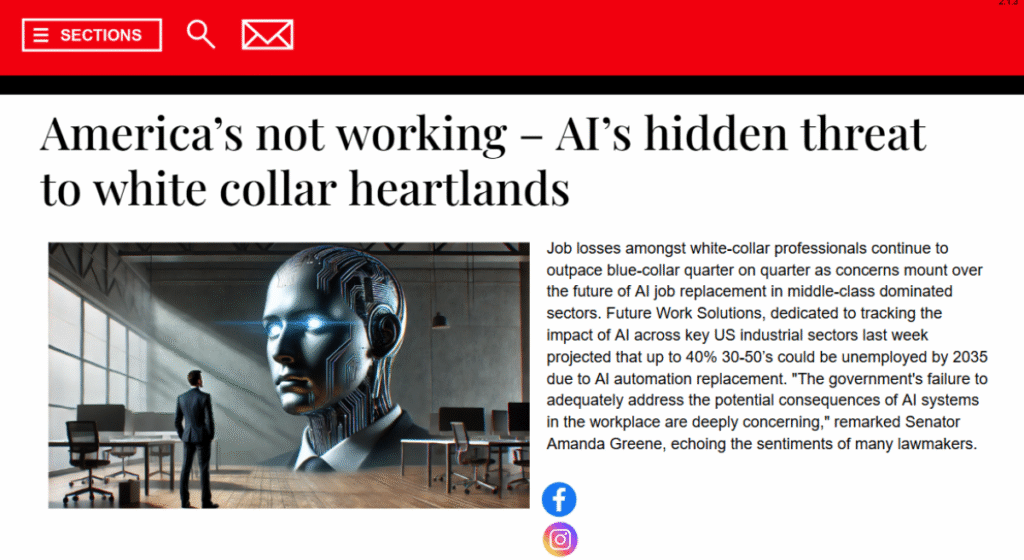
Sound familiar?
It bears a striking resemblance to headlines that have begun since the game ran. Forbes, for example, wrote in August 2025 about the “white-collar crack-up”, noting that “here in California, our once-invincible white-collar economy is beginning to shatter.”
A direct comparison illustrates the similarity:

At first glance, examples like this appear striking. But anecdotes alone can be misleading. A single headline may resemble reality simply by chance, particularly when dealing with large numbers of hypothetical developments. To avoid this, we looked at the data across the entire set of injects created for the game.
In total, the team developed 185 injects ahead of the game event on July 10th 2024.
Some represented different severities or variants of the same underlying event; once these were consolidated, we were left with 121 distinct injects.
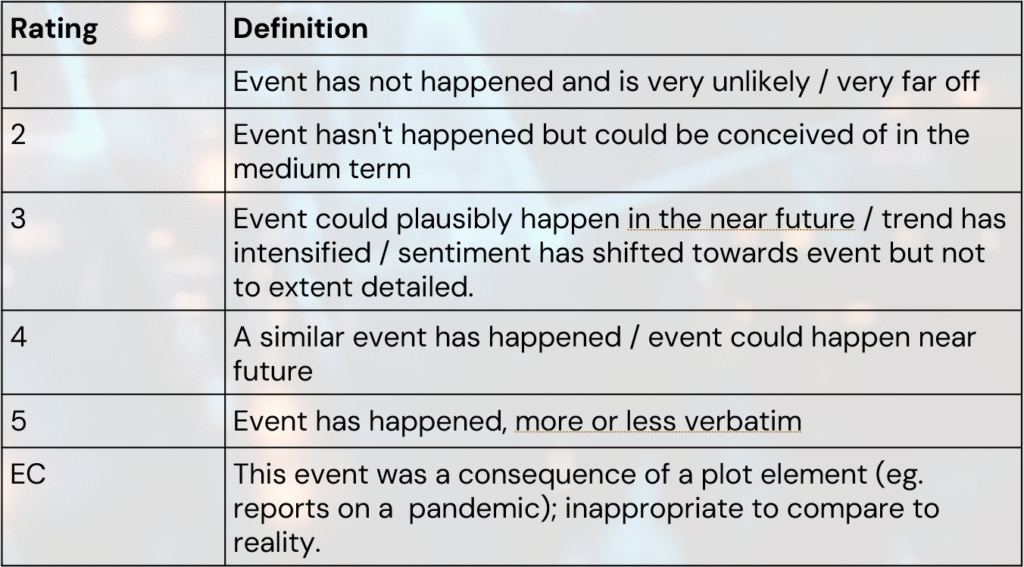
When we assessed how these compared with real-world developments over the following two years, the results were notable:
- 34 of 121 injects scored 4 or 5 on our accuracy scale (29%)
- 7 of 121 occurred almost verbatim (6%)
- 55% of injects scored 3 or higher
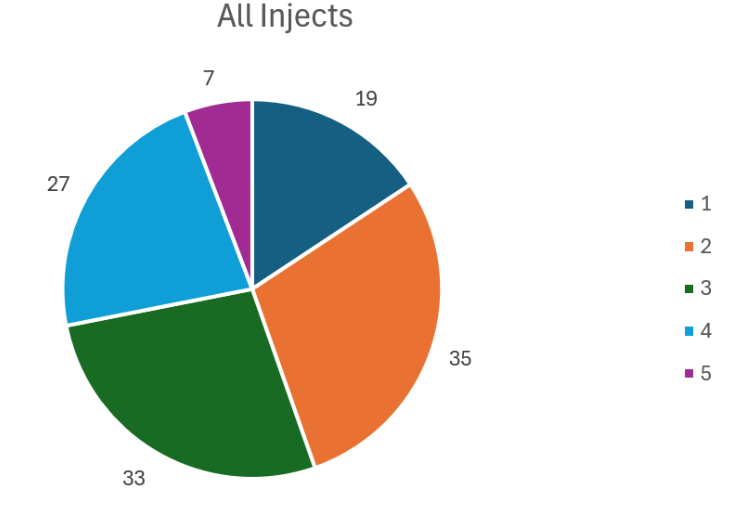
In other words, nearly one-third of the injects we created had either occurred or very nearly occurred between the game’s design in early 2024 and the time of this analysis. Not only can leaders consider how to interpret real-world developments as they emerge, in many cases, the potential issues they practised mitigating actually played out in reality over the subsequent two years.
The scenario was written and play-tested in early 2024, with the in-game timeline running from 1 January 2025 to 31 December 2032. This analysis was conducted in December 2025, roughly one year after the projected start of the scenario.
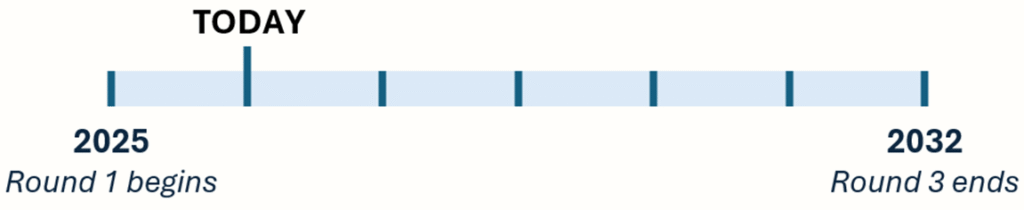
In other words, only one seventh of the game’s timeline – around 14% – had passed. Yet already 29% of the injects have scored a 4 or 5 on our scale of real-world similarity.
In effect, developments appear to be unfolding at more than twice the pace implied by the scenario’s original trajectory.
However, before exploring specific examples in more detail, an obvious question needs to be addressed.
Is this just confirmation bias?
Before addressing this in a topic-by-topic comparison, it is worth clarifying what kind of “accuracy” is meaningful in the context of these games.
The objective is not to predict precise headlines, dates, or specific technological breakthroughs. Rather, the aim is to identify the longer-term tensions and pressures shaping the system, and to capture the feedback loops, trade-offs, and constraints that leaders are likely to confront. When real-world developments begin to resemble the injects created during game design, this suggests that the SMEs successfully identified the structural forces influencing events, rather than relying on arbitrary speculation.
This approach also reflects a broader limitation in how many organisations think about risk. Traditional risk analysis often prepares organisations for discrete failures — event X or event Y. In reality, however, organisations frequently operate on the implicit assumption that only one major disruption will occur at a time. While this may be reasonable under normal conditions, it becomes fragile when multiple stresses emerge simultaneously, which they often do.
For this reason, the games deliberately introduce compounding pressures and unexpected shocks in order to stress-test strategies. Some injects therefore represent highly uncertain or low-probability events; for example, pandemics, solar storms, or other systemic disruptions, all designed to explore how leaders respond when the wider system is already under strain.
These ‘outlier injects’ are not included in the accuracy analysis presented here. Exploring how healthcare systems might respond to extreme pressure, for example, is a useful exercise in the aftermath of COVID-19, but their inclusion does not imply a prediction that a similar event will occur within the timeframe of the scenario. They are included in the game design to test resilience, and are excluded from the accuracy metric on that basis.
One final point is worth noting before moving into the deeper analysis. The game is designed as a story-led, progressive environment in which players have considerable freedom to shape events. As a result, later injects are often heavily influenced by the decisions taken during gameplay.
This raises an obvious question: how should accuracy be assessed in situations where the trajectory of events is shaped by player choices?
Our view is that, in these cases, it is less important for developments to match real-world events exactly. What matters more is that they remain plausible within the near-term strategic environment. After all, these pathways could only be tested directly if real-world policymakers were to make the same decisions as those taken by players during the game.
Takaing a broader view
The table below provides a sample of injects that scored 4 or 5 on our similarity scale. Future articles will examine these themes in more detail, looking at how individual injects compare with subsequent events and what this tells us about the underlying pressures shaping the system.
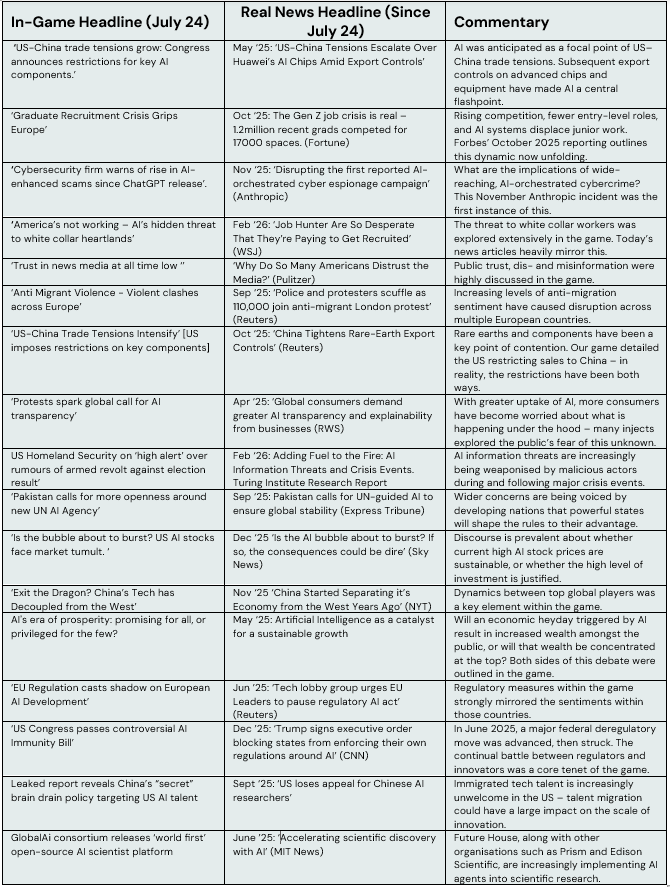
The injects produced during the design process did not emerge as isolated predictions. Instead, clear patterns emerged across the game design, reflecting the structural pressures the SMEs believed most likely to shape the trajectory of AI’s development. When we reviewed the injects collectively, they clustered around several recurring themes.
Four of these themes are particularly visible.
- The first concerns economic transformation, particularly the effects of AI on labour markets and productivity.
- The second examines social and political pressures, including how technological change can amplify existing tensions around migration, inequality, and public trust.
- A third theme focuses on technological risk and security, exploring how increasingly capable AI systems may reshape cyber conflict and questions of responsibility.
- Finally, the scenario examined information, trust, and social cohesion, looking at how AI-generated content may affect the credibility of media and public institutions.
Summary
In summary, Intelligence Rising did not just explore surface-level issues. We identified structural fault lines in today’s landscape:
AI-enabled cyber escalation,
declining media trust,
geopolitical competition for compute,
and the tension between innovation and governance.
Many of our extrapolations from the dynamics embedded in the 2024 design now read less like speculation and more like description.
The purpose of our games is not to predict exact headlines; they are to help leaders internalise how decisions interact under pressure. In the years since the game, reality has moved quickly; the constant interactions between rapidly advancing technology and the geopolitical landscape continue to create challenges for our leaders to solve.
At i3 Gen, our aim is to allow our leaders to be better prepared for the future by realistically rehearsing tomorrow’s challenges today!
Over the next few weeks we will be publishing a deeper dive into the forecasts and reality on a sector by sector basis, and these will be linked here as updates.