Damned Lies and Statistics’ is a phrase popularised by, and sometimes erroneously attributed to, Mark Twain.
It speaks to the malleability of ‘Facts and Figures’ when seeking to convey a point of view and grant it some degree of authority — because of course, if you provide independent evidence that seemingly supports your argument, then it should be that much more persuasive!
Right?
Wrong; Facts and Figures alone are not persuasive. They are cold, dull, and decidedly unengaging. It is the story that is woven around them that becomes persuasive; the story that engages our emotions, challenges us to think, and drives us to react.
Successful Sales and Marketing professionals know this, either by instinct or training.
Early in my career, I attended a Sales Training course and had a lengthy discussion with the instructor about the importance of clear facts and figures in the sales process. I was adamant that if we produced clear evidence that a particular product performed better, offered better value, and had a track record of satisfied customers, then the ‘selling’ was all but done; it would be a clear and logical decision. Why would anyone not choose the ‘obviously’ better product? [ I did say this was EARLY in my career 🙂 ]
In contrast, the course instructor was equally adamant that “facts were not persuasive” — he was not arguing that they didn’t have a role to play, but that the selling process had very little to do with the facts of the matter.
Much later in my career, I attended a different sales course that taught the Solution Selling™ methodology — on the first day, the buying process was summarised in a very clear and succinct manner:
We buy emotionally for logical reasons!
This principle applies to all of us, in every buying situation. The only variance is how much logical justification, for our emotional decision, we need to feel comfortable; this, in turn, is often related to the cost, and/or the level of buying authority we have.
That simple phrase underpins the whole process of Sales and Marketing and the wider topic of Influence.
In seeking to influence, our primary goal must be to engage our target audience on an emotional level. This applies whether we are trying to influence them in a buying process, or significantly, in a political or military scenario. Once we have gained emotional ‘buy-in’, we must also provide congruent information that allows them to feel justified in their (emotional) decision.
This may be stating the obvious, but it’s important to keep this front of mind when we consider how to engage a target audience.
Narrative does not equal Story
In recent times, we have faced torrents of ‘Fake News’. These stories are designed to engage and challenge our emotion-based decisions. We’ve typically ‘decided upon’ these views after having read a clear and authoritative ‘narrative’ about this issue or that or we’ve already been beguiled by a well-crafted story.
Afterwards, mere facts and figures would not be effective in persuading us to change or at least question our comfortable, justified position. In most cases, if we are sent a fact-based challenge to the original ‘narrative’, we probably will not invest the time to even consider this opposing perspective. We are already emotionally invested in our Point of View.
This is the problem with ‘Narratives’ versus ‘Stories’…
Isn’t this just semantics?
Aren’t Narratives and Stories just different words for the same thing?
Well actually no, they are not the same thing, but both do have their place in a communications and influence campaign.
At the 2018 NATO Strategic Communications conference in Riga, Alex Aitken, Executive Director, [UK] Government Communications, stated during the panel Q&A
A story is different to a narrative. A story has character, plot, setting, conflict, and resolution, whereas a narrative is an explanation of things.
Alex Aitken
He goes on to urge us, in our democracies, to be better at telling stories!
The power of Story is built into our core psyche.
We need to remember that a story does not mean a work of fiction. The oral tradition helped bring about the growth of civilisation and the advancement of humankind ever since.
Stories inspire! Stories scare us and keep us safe! Stories make us feel part of a community, and different stories can bring us into multiple communities.
Stories Influence!
In the absence of a compelling or engaging story; we make one up and tell ourselves it — it helps us order the world, understand the complex and be able to in turn relate issues to others.
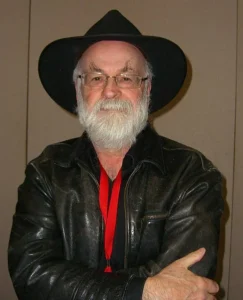
As the late, great Sir Terry Pratchett wrote in book II of his Science of Discworld series (well worth reading) …
“The anthropologists got it wrong when they named our species Homo Sapiens (‘wise man’).
In any case it’s an arrogant and bigheaded thing to say, wisdom being one of our least evident features.
In reality, we are Pan Narrans, the storytelling chimpanzee.”
So how can we be better at telling Stories?
Well, there is much great content out there on telling good stories, and it is very much in vogue in the Social Media and Content Marketing domains — so much so, that the topic is being overrun by very lightweight pieces of content that are little more than clickbait.
However, my point of view is that a good story needs to start and end with people — we need to have empathy in some manner, if we don’t care about the characters then we won’t remember the story. A forgotten story has no influence and moreover is never retold!
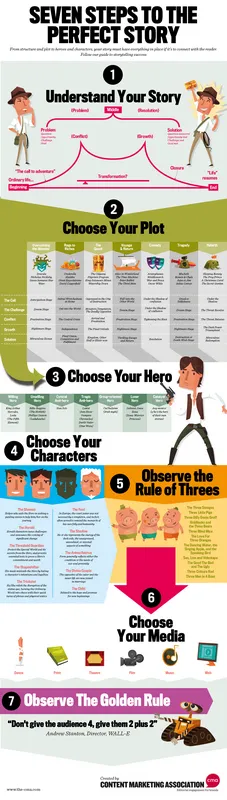
Many people have spent years trying to understand the art of storytelling and some have gone on to create guides and frameworks to help us all tell better stories. Back in 2001 Jason Ohler adapted some work by Brett Dillingham to create a simple but powerful visual portrait of a story.
In 2012 The Content Marketing Association combined this Visual Portrait with other research, notably that of Christopher Booker on the 7 archetypal story plots, and created this very useful Infographic — The Seven Steps to a Perfect Story.
y friend, Jeremy Waite, who is a great marketer and wonderful story-teller in his own right, has posted a number of articles on what makes a great story, and in 2014 wrote considered the 7 plots from a Business and Brand Perspective.
A more recent post of Jeremy’s, from December 2016, is a masterclass in preparing compelling presentations — I encourage everyone to invest a lot of time reading it; follow the links and references as well. It will pay back dividends! The Shape of My Perfect Keynote? He demonstrates it again here when he deconstructs the highly engaging and entertaining (I know I was there) keynote of the Canadian Astronaut Commander Chris Hadfield.
Every good storyteller knows you need to have meaningful and memorable soundbites. They are the hooks we remember both the stories and the storytellers by.
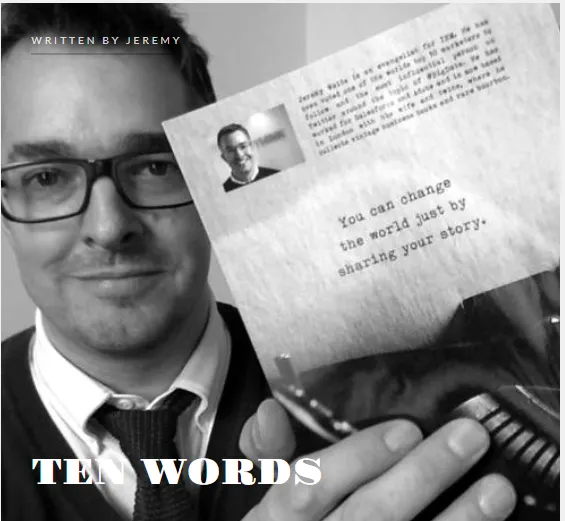
Jeremy picked up on this a while back, and last September published his latest book ‘Ten Words’ — again I commend it to you along with the accompanying PodCast series.
To give you a flavour of its content and how powerful and influential words can be — have a read of this: The Best Business Advice I’ve Ever Received — when you read the selected quotes in that article, they clearly all share the same two traits: People and Emotion.
UPDATE: This Blog was originally written in 2018 — Jeremy has gone from strength to strength since then, and I highly commend his website betterstories.org for the best collection of materials to make you a better storyteller!
This is where a ‘narrative’ falls short as a vehicle for influence.
When a narrator describes a scene or provides a link between situations — they are performing a mechanical act in the story — they are outside of the story itself.
When a narrative describes, clearly and factually, an important situation or issue, they are trying to rise above the emotion, they are seeking to present a picture, an explanation.
A good narrative will provide a model from which we base our stories upon and should cover the following factors:
- Purpose
- Objectives
- Key Messages
- Planned Counter-Messages
- Supporting Content
- Desired Effects
- Target Audiences
- Specific Activities
- Management Processes
- Identified Communications Platforms and Media
- Measurement and Reporting
A narrative is a strategic plan whilst our stories are the tactical execution of that plan.
A narrative should provide us with talking points, but then we must be trusted to take those talking points and make them into our own stories.
We are all different. We have different styles, influences, vernacular and colloquialisms and of course different audiences. This is why, to be authentic, we need to tell our stories as individuals, not as ‘repeaters’ of Official or Corporate communications.
Good Marketing is all about devising and telling great stories.
When it comes to Story Telling in Marketing, in my opinion, there is none more capable and more influential than Seth Godin. He even wrote a book on it, “All Marketers Are Liars” it’s title caught my eye 😉 , however, as you can see, it has since been updated.
In it, Seth presents case after case of influence through stories. That’s his style by the way, he doesn’t tell you what you should be doing, but tells you stories about things he has seen and how they have worked or haven’t — he allows you to draw the lessons from those stories, and every one of his stories has people, setting, plot and emotion!
In this book, he shows the power of Stories to overcome the plain objectivity of fact; the book jacket text states
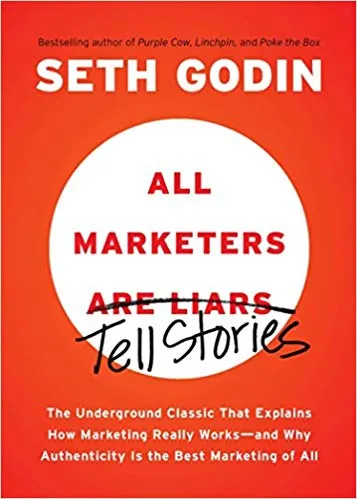
“All marketers tell stories. And if they do it right, we believe them. We believe that wine tastes better in a $20 glass than a $1 glass. We believe that an $80,000 Porsche Cayenne is vastly superior to a $36,000 VW Touareg, even if it is virtually the same car. We believe that $225 Pumas will make our feet feel better — and look cooler — than $20 no names… and believing it makes it true.”
Again, People and Emotion!
If you are new to Seth Godin, then I strongly recommend you buy his books and subscribe to his daily blog– the blogs are normally 1 or 2 paragraphs of pithy, insightful and usually thought-provoking commentary.
The reason Seth chose the provocative book title was itself an example of good story craft — the wiki page for the book states that in his introduction to the book Seth wrote:
“I wasn’t being completely truthful with you when I named this book. Marketers aren’t liars. They are just storytellers… I was trying to go to the edges. No one would hate a book called All Marketers Are Storytellers. No one would disagree with it. No one would challenge me on it. No one would talk about it.”
How to compete and win with Story Telling?
My career has been in Business-to-Business Marketing, and more recently, I have been working within the military sector, combining the skills and practices of business marketing with those of Strategic Communications and Information Operations.
Update: Which we now also base our Enhanced Narrative Wargaming on!
There is a lot of common ground between Marketing and Warfare, especially regarding strategy and planning.
A great book that draws analogy and provides great guidance to marketers is Marketing Warfare by Al Ries and Jack Trout — first published in 1986 and updated in 2005 — the book remains highly relevant and well worth reading as is their other short and punchy book, The 22 Immutable Laws of Marketing , which I will draw upon next. (You can read a 2000 word summary of the book here).
Assuming we know how to craft emotionally engaging stories. When it comes to winning with stories, the first 2 laws are paramount.
#1 The Law of Leadership — It’s better to be first than it is to be better!
Because it is easier to get into the minds of your audience first, than it is to convince them that you are a better choice than the one that did get there first.
#2: The Law of the Category — If you can’t be the first in a category, set up a new category you can be first in
Don’t ask yourself how you are better than the competition; ask yourself in what category you can be first. [Basically, if you are not first in your category then you make up a new category name and claim leadership within it — this technique is especially prevalent in the Tech Sector!]
So clearly, the best strategy is to tell our story first and to tell it well!
If we do this then we will carry your audience with us and they will stay loyal against an onslaught of ‘challenging narratives’.
If we are not first; if some other ‘narrative’ or more likely, some other stories are influencing our target audience, then the absolute worst strategy is to try to ‘win the narrative’ by challenging their stories; especially if they are fake stories! All we do is give these fake stories ‘credibility’ and ‘fuel their propagation’.
It is far better to create our own stories and tell them louder and better — create our own category where we are the leader, and the target audience is engaged with us.
As an example: Whilst I fundamentally disagree with President Trump on pretty much everything; I do acknowledge his mastery of telling stories; engaging the audience and simply not engaging with any contrary story position. What do his critics and competitors do? They challenge his stories with facts, in the belief that facts alone will cause his emotionally invested audience to change their point of view! The ‘trump approach’ has such a disregard for facts, they know they are not persuasive, they even went as far as presenting ‘alternative facts’!
To challenge President Trump, President Putin, or any other Populist or Authoritarian based Narrative model — we need to create a NEW set of stories; our own stories, that the target audience will empathise with and that we can tell loudly and proudly!
To challenge an audience’s belief, we need to present an emotionally engaging story that they can invest in, and one that is more advantageous than the ones they are currently believing.
By the way, if the current ‘true story’ is quite negative, a target audience will readily consider a positive alternative story, regardless of its veracity — this is what happened in the case of the Skripal Poisoning. — The factual narrative was quickly undermined by a tidal wave of alternative stories from Russia. These presented a slightly less negative perspective for the audience to consider, and add into the mix, influential voices from within the UK supporting these ‘questioning stories’ then very quickly, the objective narrative lost a large degree of its influence effect.
FACTS and TRUTH
Throughout this article, I have argued for the power of good storytelling and have downplayed the role of factual narrative. This may seem as if I don’t place value on Truth. If this is the case then let me assure you that I consider Truth to be paramount. Anything that is built on lies will, sooner or later, collapse; the later it is the more catastrophic the collapse will be!
I started with an emotive quote, so to conclude I shall go further back for the concluding quote:
If the truth were self evident, eloquence would not be necessary
Marcus Tullius Cicero